


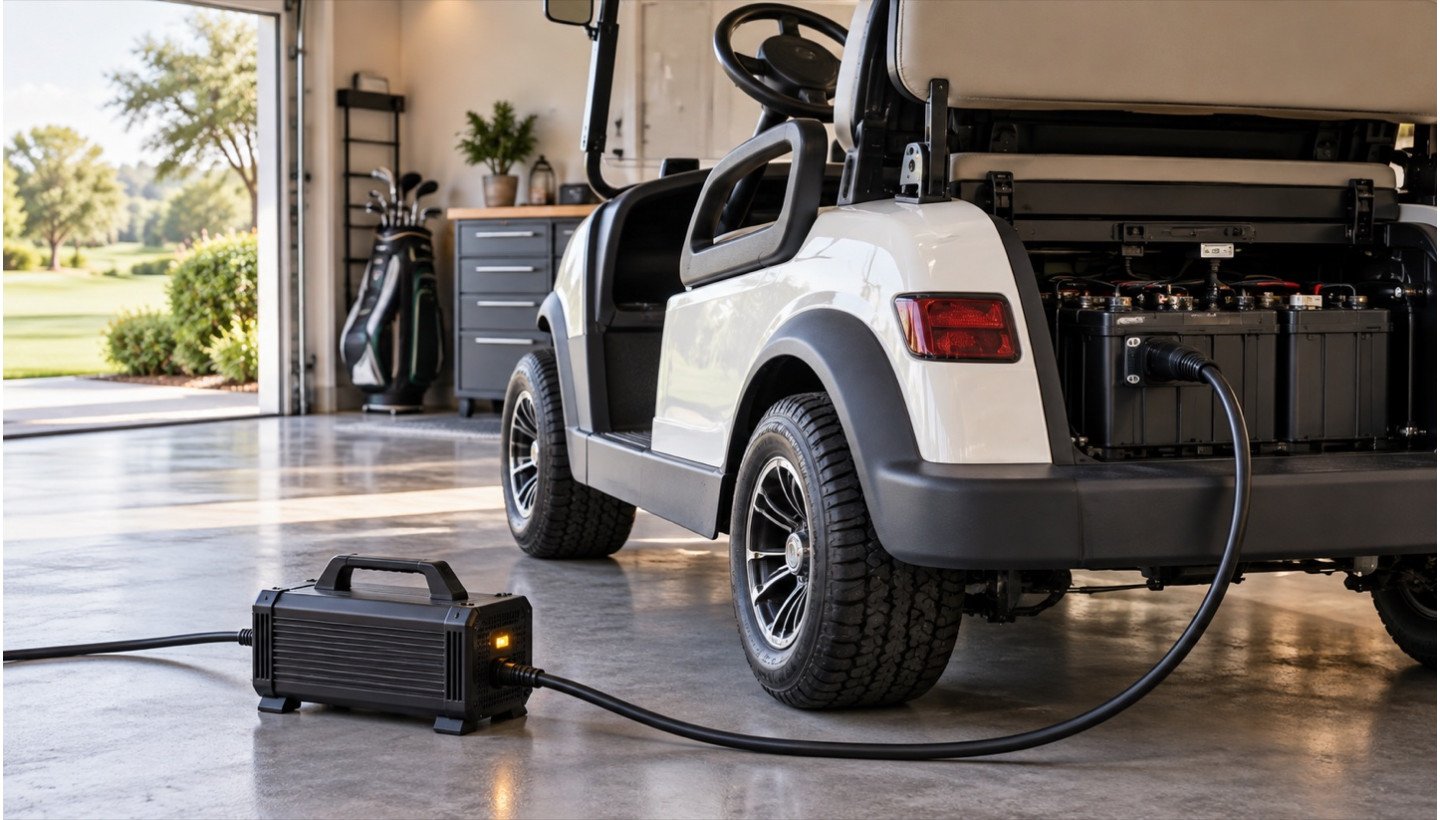
Start with your cart, not the charger
A replacement charger protects one of the most expensive systems on an electric golf cart: the battery pack. The right choice matches four things - pack voltage, battery chemistry, charge-port connector, and an amp rating that fits the pack. Get one of them wrong and a charger may refuse to start, charge too slowly, or damage the batteries.
This guide compares six smart chargers for 36V and 48V carts, then gives you a practical way to narrow the list before you buy.
Quick answer: For a lead-acid cart, a 15A smart charger is a sensible starting point only after the voltage and cart-side plug match. For a lithium conversion, use the battery manufacturer’s approved voltage, current and charger profile - not a generic 48V replacement. If you cannot confirm all three, pause before ordering.
Quick comparison: the six chargers at a glance
| Charger | System | Output | Best fit |
|---|---|---|---|
| Lester Summit II 650W | 24V / 36V / 48V | Up to 17A | Most flexible premium smart charger |
| MODZ Max48 | 48V | 15A | 48V lead-acid storage and maintenance |
| FORM Charge | 36V or 48V model | 15A / 18A | Rugged dual-chemistry mid-range option |
| 10L0L 48V Smart Charger | 48V | 15A | Bluetooth monitoring at a lower price |
| DC HOUSE 48V Lithium | 51.2V nominal lithium | 18A | Dedicated LiFePO4 conversion |
| EPOWREY | 36V or 48V model | 18A / 15A | Budget upgrade for compatible lead-acid carts |
Choose the charger that solves your actual use case
Lester Summit II 650W
Best overall smart charger. A multi-voltage option for owners who want manufacturer-specific charge profiles, app controls and the flexibility to keep the charger when the cart changes.
MODZ Max48
Best 48V storage pick. A 15A charger for 48V carts when off-season maintenance and weather-resistant construction matter more than multi-voltage flexibility.
FORM Charge
Best rugged mid-range choice. Pick the correct 36V or 48V version if you need a charger designed for a garage or shed and your battery maker approves its chemistry profile.
Three more options worth comparing
10L0L 48V Smart Charger
Best for app-based monitoring. It brings live charge-stage, voltage and current viewing to a lower price point. Confirm the supplied plug and any Club Car OBC guidance for your exact cart.
DC HOUSE 48V Lithium
Best dedicated lithium charger. A fast 18A choice for a compatible 51.2V LiFePO4 conversion. Treat the battery manufacturer's approved charge voltage and connector as the final authority.
EPOWREY
Best budget upgrade. A lighter, higher-output replacement for a compatible 36V or 48V lead-acid cart. Check the listing carefully: voltage, plug and chemistry vary by version.
Four checks to make before you order
-
Confirm pack voltage
Read the label on the existing charger, count the batteries in the pack, or check the cart manual. A 36V charger and a 48V charger are not interchangeable.
-
Match battery chemistry
Flooded lead-acid, AGM and LiFePO4 packs do not use the same charging profile. Use the battery maker's approved charger specification.
-
Identify the connector
Photograph the cart-side receptacle and compare it with the listing. Similar-looking Club Car, E-Z-GO and Yamaha plugs are not always compatible.
-
Choose sensible amperage
Higher current can reduce charge time, but the battery pack sets the safe limit. Start with the manufacturer's recommendation rather than choosing the largest number.
Do not choose by cart brand alone: Club Car, E-Z-GO and Yamaha have used more than one charge-port arrangement across models and years. A seller claim such as “fits Club Car” is not enough - compare your actual receptacle and the charger version listed for it.
Use the plug as a second compatibility check
| Cart family | What can vary | What to confirm before ordering |
|---|---|---|
| Club Car | Round 3-pin, crowfoot/PowerDrive and OBC-equipped arrangements vary by model and year. | Exact receptacle shape and whether the seller gives model-specific OBC instructions. |
| E-Z-GO | D-style and triangular/Powerwise-style versions are not interchangeable. | Cart model, plug shape and the charger’s stated voltage. |
| Yamaha | Connector styles can change between cart generations. | Plug photo, cart model/year and the charger listing’s fitment notes. |
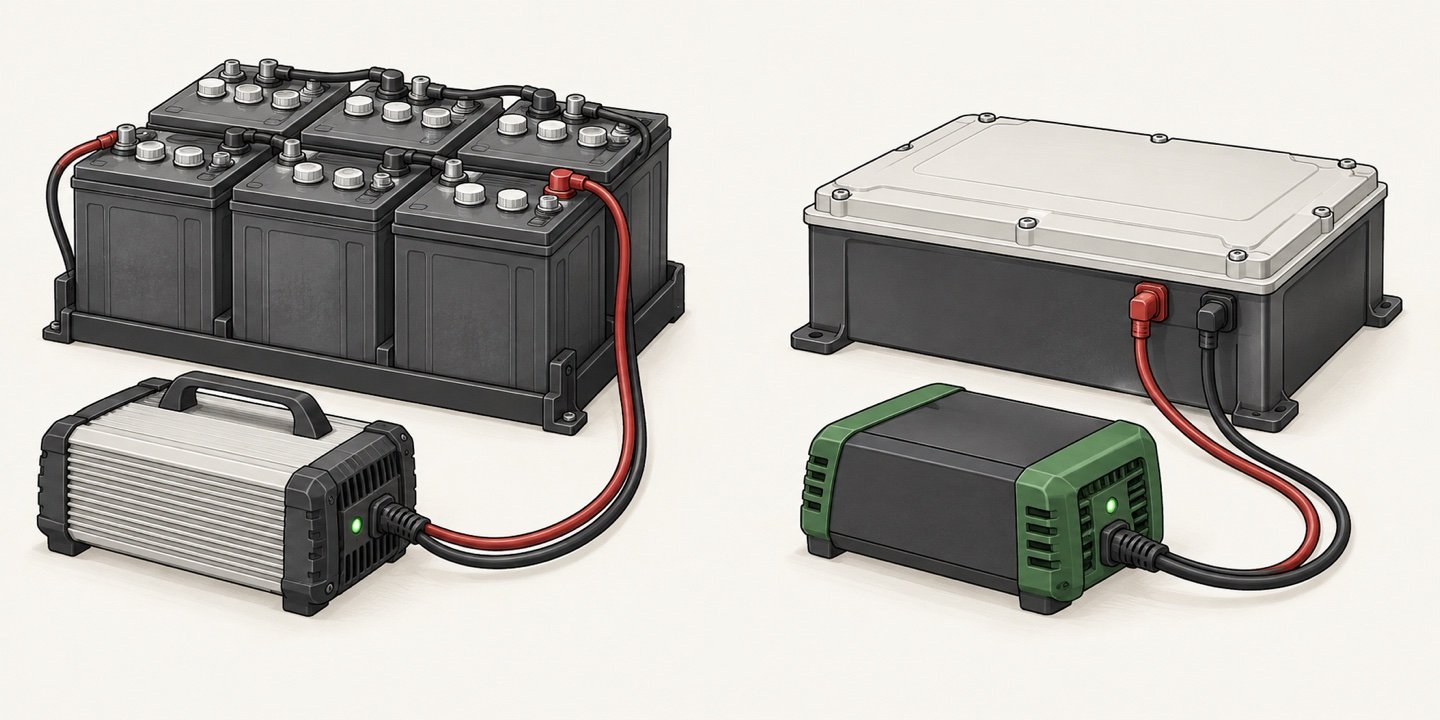
Battery chemistry changes the answer
For a traditional flooded lead-acid pack, look for the profile and maintenance behavior recommended by the battery maker. Those packs commonly benefit from a correctly controlled maintenance stage during storage, but they still need periodic water-level checks where applicable.
For a lithium conversion, use a charger explicitly approved for that battery's voltage and chemistry. A lithium battery's BMS and charger need to work together; do not assume that a generic lead-acid maintainer is suitable.
Safety note: Never use voltage alone as proof of compatibility. The battery documentation, charger listing and connector must agree before charging.
How much charger amperage do you need?
As a useful starting point, many golf-cart packs charge well with a charger rated at roughly 10% to 15% of the pack's amp-hour capacity. That is a sizing shortcut, not a substitute for the battery maker's instructions.
For a planning estimate, divide the amp-hours you need to replace by the charger’s rated amps, then add roughly 15% for losses and the final charge stage. A 225Ah pack at about 50% state of charge needs roughly 113Ah back: 113 ÷ 15 × 1.15 is about 9 hours before temperature and battery condition are considered.
225Ah lead-acid pack
A 15A to 22A charger is a common range. A pack discharged to about half capacity may take roughly 8 to 10 hours at 15A, depending on temperature, losses and the final charge stage.
260Ah lead-acid pack
An 18A to 25A charger is a common starting range. Larger capacity can justify more current only when the battery specification permits it.
100Ah lithium pack
A 15A to 25A charger can be appropriate for some conversions, but lithium charge limits vary by battery and BMS. Check the published charging-current limit first.
Two fitment details that catch buyers out
Club Car OBC
Some electric Club Car DS and Precedent models use an On-Board Computer originally designed around an older factory charger. A modern replacement must be compatible with that system or use the exact model-specific installation method supplied by the cart or charger manufacturer. Do not apply a generic bypass instruction to a cart you have not identified.
Winter storage
A smart storage or maintenance mode is safer than leaving an unregulated trickle charger connected for months. For flooded batteries, inspect electrolyte levels as the battery maker directs even when a smart charger is connected.
Frequently asked questions
Can I use a 48V charger on a 36V golf cart?
No. Use a charger designed for your actual pack voltage. A 48V charger can overcharge a 36V lead-acid pack; a 36V charger will not correctly charge a 48V pack. A multi-voltage charger is only suitable when it explicitly detects and supports your pack.
How long does a 48V charger take to recharge a golf cart?
It depends on amp-hour capacity, depth of discharge, charger current, temperature and the final charging stage. As a rough guide, a 225Ah lead-acid bank at about 50% state of charge can take around 8 to 10 hours with a 15A charger. Treat any published estimate as a planning range, not a promise.
Why will a new smart charger not start?
Many smart chargers need to detect a minimum pack voltage before they activate. Check the outlet, connector, pack voltage and any cart-specific charging interlock first. If the pack is deeply discharged, ask a qualified golf-cart battery technician for help rather than bypassing safety logic.
Can I leave a smart charger connected all winter?
Only if the charger and battery manufacturer both approve that storage use. A maintained lead-acid pack can still need water-level checks, and lithium storage guidance varies by battery brand. Do not treat “automatic” as permission to ignore the battery manual.
The short version
Choose the Lester Summit II when you need premium multi-voltage flexibility. Choose the MODZ Max48 for a 48V cart that spends time in storage. Consider FORM Charge or 10L0L when their exact voltage, chemistry and connector version matches your cart. For a 51.2V LiFePO4 conversion, choose a dedicated charger such as the compatible DC HOUSE model only after checking the battery maker's charging specification.
Your last step should always be the same: compare the cart's voltage, battery documentation and charge-port plug with the seller listing before you order.